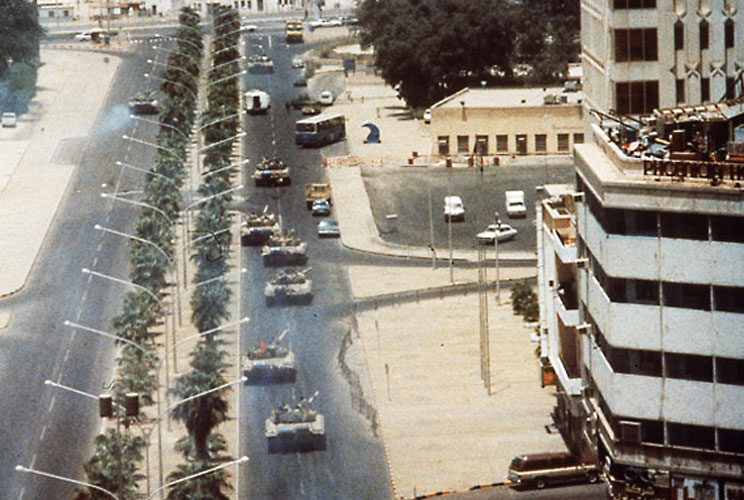


In the quiet hours before dawn on this day in 1990, the desert border between Iraq and Kuwait erupted into violence. Iraqi tanks surged across the frontier, supported by armored divisions and elite Republican Guard units. Within hours, they seized Kuwait City, toppled the government, and declared the small Gulf nation Iraq’s nineteenth province.
The invasion shocked the world. But for Kuwait and the Gulf Cooperation Council (GCC), it was more than a shock, it was a geopolitical earthquake that reshaped the region’s security landscape forever.
The Gulf’s Fear of Iran
When the Iranian Revolution toppled Iran’s monarch, Mohammad Reza Pahlavi (known as the Shah), in 1979, a new theological regime headed by Ayatollah Ruhollah Khomeini ascended to power. The Gulf Arab monarchies felt a chill unlike anything they had experienced. Khomeini’s message was explicit: monarchy was illegitimate, hereditary rule was un‑Islamic, and the Gulf’s rulers were “corrupt” custodians of oil wealth that, in his view, did not rightfully belong to them.
Iran adopted a new policy — Exporting the Islamic Revolution — signaling that the clerical leadership did not intend to remain confined within Iran’s borders. Tehran encouraged Shi’a communities in Iraq and the Arab Gulf states to rise up against their governments. The Gulf states — small, wealthy, and militarily fragile — suddenly felt exposed.

By mid‑1980, Iranian forces were massing in attack formations along the 745‑mile (1,200 km) border with Iraq. Geography favored Iran: the Iraqi capital, Baghdad, was only 74 miles (120 km) from the frontier, within reach of Iranian short‑range missiles. Tehran, by contrast, sat 440 miles (700 km) from Iraq’s border — safely out of range.
Iraq concluded it had only one viable option: strike first. Push Iranian forces deep into their own territory, move the battle away from Iraqi border towns, and place Baghdad beyond missile range.
Iranian state media framed Iraq’s move as an invasion and vowed to fight until Saddam Hussein and his ruling Ba’ath Party were toppled.
The GCC saw something different: a buffer — a secular Arab state standing between them and a revolutionary theocracy that openly threatened their survival.
The Gulf’s Investment in Iraq
Throughout the eight‑year Iran‑Iraq War, Kuwait, Saudi Arabia, and other Gulf states poured billions into Iraq’s war effort. They financed weapons, extended loans, and provided diplomatic cover. Kuwaiti tankers were reflagged under the U.S. flag to protect them from Iranian attacks.
To Gulf rulers, supporting Iraq was not charity. It was self‑preservation.
Across the Arab world, Saddam Hussein was celebrated as the defender of Arab identity against Iran. His portrait hung in homes from Morocco to Oman.
The Gulf believed that if Iran defeated Iraq, the clerical regime would turn its attention southward — toward the oil‑rich monarchies lining the Gulf. Iraq was the wall that kept Iran at bay.
But when the war ended in 1988, that wall began to crack.
A New Regional Superpower
Both Iran and Iraq emerged devastated, but Iraq gained something dangerous: prestige. Saddam had fought Iran to a standstill. His army was massive, battle‑hardened, and experienced. His arsenal was one of the largest in the Middle East. His air force was strategic and superior. His propaganda machine — backed by cheering Arab masses — portrayed him as the defender of the Arab world.
Regional and global powers noticed — and many were uneasy.
A strong Iraq threatened the traditional hierarchy of Middle Eastern power. Western governments were wary of Saddam’s worldview, especially his refusal to normalize relations with Israel. The Gulf states sensed this discomfort and quietly aligned themselves with it.
Kuwait, in particular, understood that the world did not want a militarily dominant Iraq reshaping the region — and used that sentiment to apply pressure.
Growing Fury
Iraq emerged from the war economically shattered. Its infrastructure was ruined, its foreign debt exceeded $80 billion, and it desperately needed high oil prices to rebuild.
Kuwait increased oil production beyond OPEC quotas, driving down global prices. For Iraq, this was catastrophic. Every dollar lost was a dollar needed to repair cities, pay soldiers, and stabilize the economy.
Saddam accused Kuwait of “economic warfare” and slant drilling into the Rumaila oil field — a charge Kuwait denied.
To Saddam, Kuwait’s actions were not mere economic disputes. They were political provocations. He believed Kuwait was exploiting global discomfort with Iraq’s rising power to weaken him.
By late July 1990, tensions were boiling. Diplomats scrambled to defuse the crisis, but Saddam had already decided Kuwait was weak, isolated, and incapable of resisting.
He was wrong about the isolation — but right about the weakness.
The Invasion
At 2:00 a.m. on August 2nd, 1990, Iraqi forces launched a coordinated assault across the Kuwaiti border. The attack was swift and overwhelming. Kuwait’s small military — fewer than 20,000 troops — was no match for Iraq’s massive army.
By dawn, Iraqi tanks were rolling through Kuwait City. The Emir fled to Saudi Arabia. Government buildings fell one by one. Within 48 hours, Saddam declared Kuwait annexed.
The Gulf states watched in horror.
For many Kuwaiti civilians, the invasion brought abrupt dislocation rather than economic hardship. Tens of thousands were already abroad for the summer when the attack occurred, suddenly finding themselves unable to return home.
In Kuwait itself, many Kuwaitis fled within days of the invasion, scattering across Saudi Arabia, Bahrain, the UAE, and Europe. Most lived in hotels, rented apartments, or stayed with relatives — a diaspora marked not by poverty, but by uncertainty. Families waited for news from home, unsure when they could return or what they would find when they did. Schools were interrupted, routines collapsed, and daily life became a suspended chapter lived far from Kuwait City.
The Long Road to 2003
The international response was swift. A UN‑backed U.S.-led coalition launched Operation Desert Shield to protect Saudi Arabia, followed by Operation Desert Storm to liberate Kuwait. By February 1991, Iraqi forces were expelled.
But Iraq paid a heavy price.
For the next 13 years, Iraq faced crushing sanctions. Its economy collapsed. Infrastructure decayed. Millions suffered. Saddam remained in power, but Iraq was isolated, weakened, and increasingly unstable.
Tensions over weapons inspections — especially with UNMOVIC — eventually culminated in the 2003 U.S.-led invasion of Iraq, toppling Saddam and reshaping the region once again.
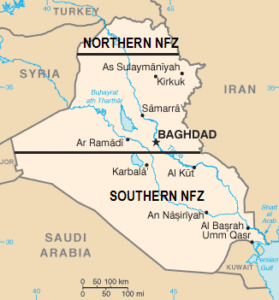
The arc from 1990 to 2003 was not a straight line, but the invasion of Kuwait was the spark that ignited everything that followed: sanctions, inspections, no‑fly zones, and ultimately war.
Legacy
The Iraqi invasion of Kuwait was more than a regional conflict. It was a moment of reckoning for the Gulf Arab states — a reminder that their wealth, small populations, and strategic location made them vulnerable not only to ideological threats from Iran, but also to military threats from Iraq.
It forced them to rethink alliances, rebuild defenses, and redefine their place in the world.
And it exposed the tragic irony of the 1980s:
The Gulf supported Iraq to protect themselves from Iran. But Iraq became the threat that nearly destroyed one of their own.
August 2nd, 1990 remains one of the most consequential dates in modern Middle Eastern history — a day when the Gulf’s fears, loyalties, and assumptions were shattered in a single night.