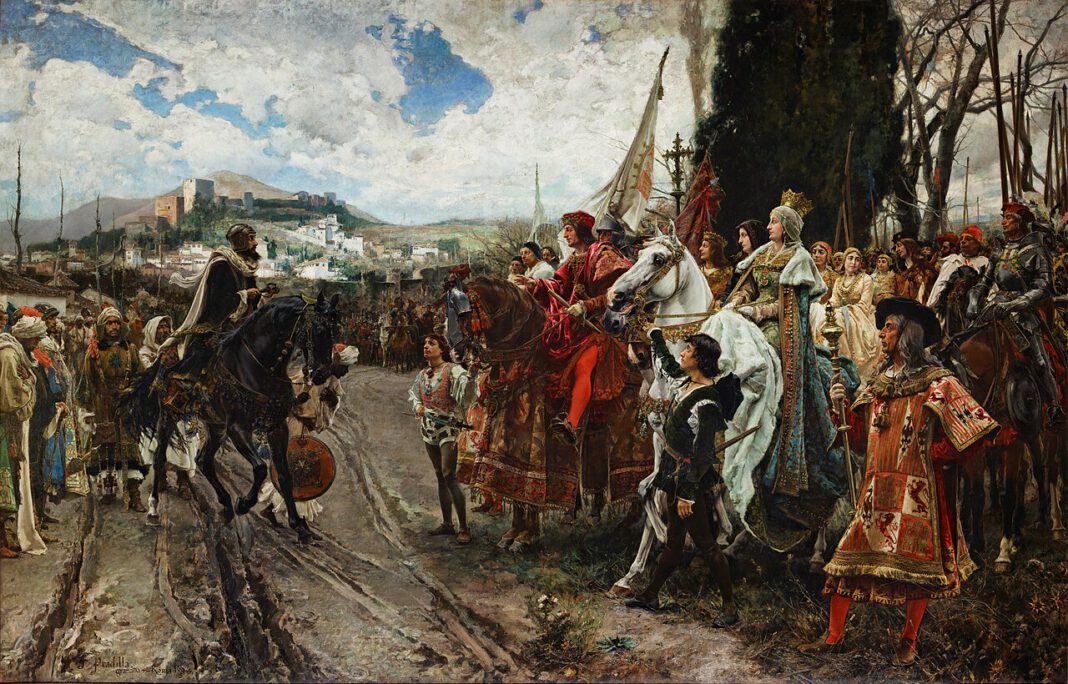


1493 – Granada
Filled with bitterness and sorrow, King Abdullah bin Muhammad of Granada signed a document to leave the city on this day. The Kingdom of Granada comprised, principally, the area of the modern provinces of Granada, Málaga, and Almería.
For centuries, Granada had been a cultural, political, and commercial center in southern Europe. The eyes of neighboring kingdoms remained alert, waiting for an opportunity to destroy the growing realm they always regarded as an invading entity.
In the late 15th century, Granada plunged into a severe struggle for power and disintegrated as a result of internal rivalries. The Catholic Monarchs took advantage of this disunity. The last king of Granada, Muhammad XI (Boabdil), who ruled from 1482 to 1492, surrendered his final stronghold — the city of Granada — on January 2, 1492.
1833 – Ottomans-Russian Alliance
The defensive alliance of Unkiar Skelessi between the Ottoman Empire and Russia was signed on this day.
1833 – Treaty of La Marsa
France imposed the Treaty of La Marsa on Tunisia on this day, formalizing French control over the country.
1913 – Mongolia
China agreed to grant independence to Mongolia on this day.
1931 – Political Imprisonment
Egyptian authorities released the noted Egyptian author Mahmoud Abbas al‑Aqqad on this day. He had been jailed for criticizing the Egyptian monarch.

1954 – Cold war
One of the hot chapters of the Cold War unfolded on this day when Col. Carlos Castillo Armas was elected president of the junta that had overthrown Guatemalan President Jacobo Árbenz Guzmán earlier that year.
The election of Castillo Armas marked the culmination of U.S. efforts to remove Árbenz and prevent what American officials believed to be an attempt by international communism to gain a foothold in the Western Hemisphere.
1969 – French in Canada
The Canadian House of Commons approved French as a second official language in Canada on this day.
1989 – Argentina’s Syrian President
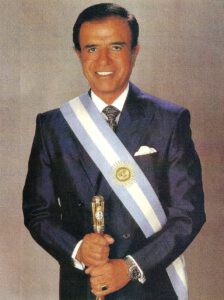
Carlos Menem of Argentina’s Peronist Party became president of Argentina on this day, the first Peronist to assume power since the death of Juan Perón in 1974.
Menem, of Arab‑Syrian origin, was born to immigrant Syrian Muslim parents. Ambitious and determined to hold power, he converted to Christianity to pursue political office.
In 2001, at 72, Menem married a former Argentine model, but his honeymoon was short‑lived when he was arrested in connection with an illegal arms‑sales investigation.
He was accused of heading an organization that sold rifles and artillery to Ecuador and Croatia between 1991 and 1995.
Menem repeatedly denied wrongdoing, insisting the sales were “absolutely legal” and claiming he was the victim of “political persecution.”
He served two consecutive terms ending in December 1999, continued as leader of his Peronist Party, and openly expressed his desire to run for the presidency again in 2003.
1995 – Espionage
Chinese authorities confirmed on this day that they had formally arrested Harry Wu, an American of Chinese origin, on charges of espionage.
The United States reacted strongly, and Wu’s wife appealed to President Bill Clinton to take “strong action” to secure her husband’s release.
Wu was sentenced to 15 years in prison, then expelled from China on August 24, 1995.
2000 – Yugoslavia
The Yugoslav Federation collapsed on this day when Montenegro withdrew its membership.
The withdrawal followed a constitutional amendment that allowed Serbian President Slobodan Milosevic to remain in power — a move Montenegro viewed as a violation of the federation’s constitution.
2001 – S Korea – Japan
Relations between Japan and South Korea reached extreme tension on this day over how Japanese schoolchildren are taught about World War II and Japan’s colonial domination of East Asia.
The controversy stems from Japan’s textbook approval system and the perception that Japan has never expressed remorse in a way acceptable to countries that suffered wartime atrocities.
All textbooks — not just history ones — undergo rigorous government screening in Japan, but it is the history books that repeatedly spark disputes, not only with neighboring countries but also within Japan itself.