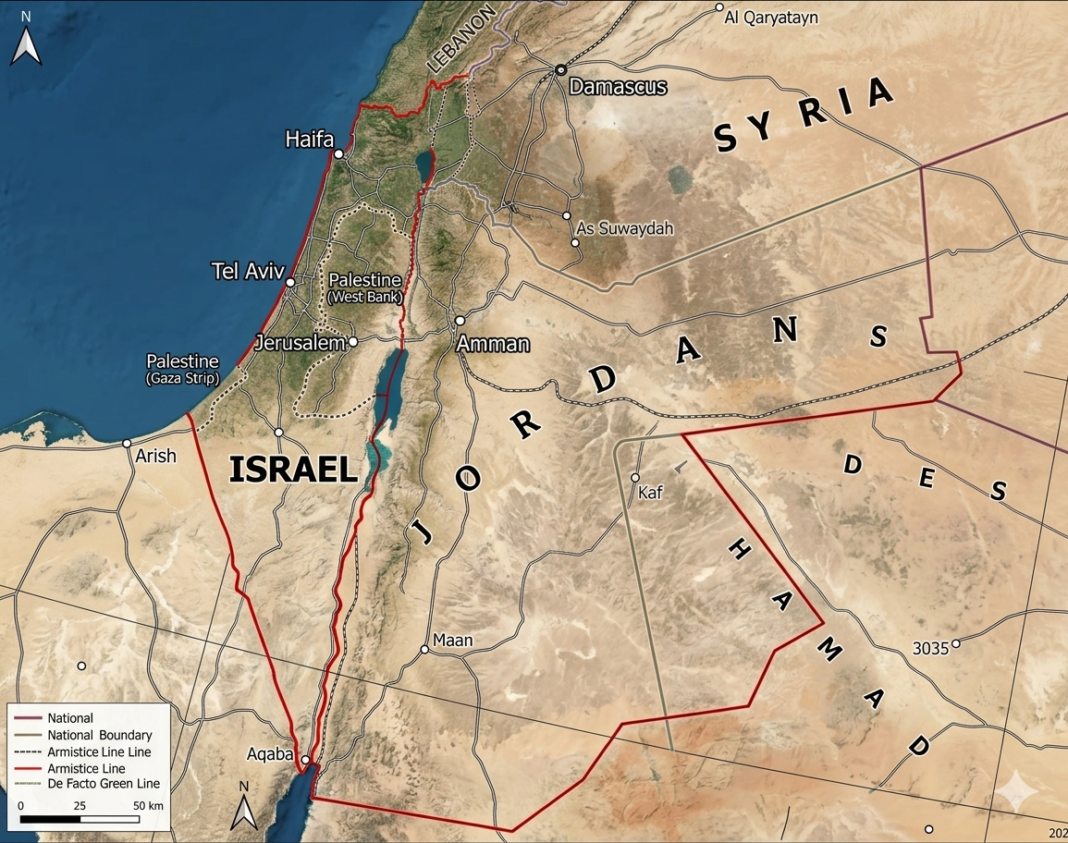


King Hussein of Jordan announced the termination of Jordan’s administrative and legal authority over the West Bank on this day in 1988, ending a relationship that had lasted for more than four decades. The decision, known as the “disengagement,” reshaped the political landscape of the Arab–Israeli conflict and marked a turning point in Palestinian national aspirations.
Jordan had annexed the West Bank in 1950, following the 1948 Arab–Israeli War and the mass displacement of Palestinians. For years, the territory was governed as part of the Hashemite Kingdom, and its residents carried Jordanian citizenship. Amman invested heavily in the region, integrating its economy, building institutions, and treating the West Bank as an inseparable part of the state. But the 1967 Six‑Day War changed everything. Israel occupied the territory, and Jordan’s role became increasingly symbolic — defined more by historical ties than by actual control.
By the late 1980s, the political environment had shifted dramatically. The first Palestinian uprising (the First Intifada), which erupted in December 1987, revealed a new Palestinian political reality: the uprising was grassroots, locally driven, and centered around the Palestine Liberation Organization (PLO), not Jordan. Palestinian leaders, activists, and ordinary citizens were asserting their own national identity with renewed clarity. The idea that Jordan should continue to speak for the Palestinians — or claim administrative responsibility for the West Bank — was increasingly untenable.
King Hussein recognized this shift. In a televised address on July 31, he declared that Jordan would sever administrative and legal ties with the West Bank. Jordanian civil servants were withdrawn, budgets redirected, and the Jordanian parliament was dissolved and reconstituted without West Bank representation. In his speech, the king stated that the decision was made “in compliance with the will of the Palestinians,” acknowledging that the future of the territory belonged to the Palestinian people themselves.

The disengagement was not merely a bureaucratic act; it was a strategic recalibration. Jordan sought to avoid competing with the PLO for legitimacy and to prevent internal political strain within the kingdom, where a large portion of the population was of Palestinian origin. By stepping aside, Hussein aimed to strengthen the Palestinian claim to self‑determination and to clarify Jordan’s own national identity and political priorities.
Internationally, the move was widely interpreted as a recognition that the Palestinian question required a Palestinian answer. It cleared the path for the PLO to present itself as the sole legitimate representative of the Palestinian people, a status that would be formally acknowledged in diplomatic arenas soon after. It also allowed Jordan to focus on its own stability, economic reforms, and regional diplomacy without the burden of a territorial claim it could no longer realistically pursue.
The disengagement did not resolve the conflict, nor did it diminish Jordan’s historical and emotional connection to Jerusalem and the holy sites. But it marked a decisive moment in Middle Eastern politics: a quiet, deliberate shift that acknowledged the realities on the ground and the aspirations of a people seeking their own political destiny.
King Hussein’s decision remains one of the most controversial acts of his reign. While one may acknowledge that sometimes stepping back is itself an act of leadership, many in the Arab world saw the move as a failure to assume historic responsibilities. In 1994, however, King Hussein addressed the nation and implied that the disengagement had been forced on Jordan by Arabs and Palestinians. He supported his claim by revealing that during the Arab summit of 1974, Arab countries requested that Jordan refrain from being the mouthpiece of Palestinians.
It is widely believed that the king’s remarks referred to the decision taken at the 1974 Arab summit in Rabat, Morocco, where Arab states recognized the PLO as the sole legitimate representative of the Palestinian people — a recognition that ultimately paved the way for Jordan’s disengagement fourteen years later.