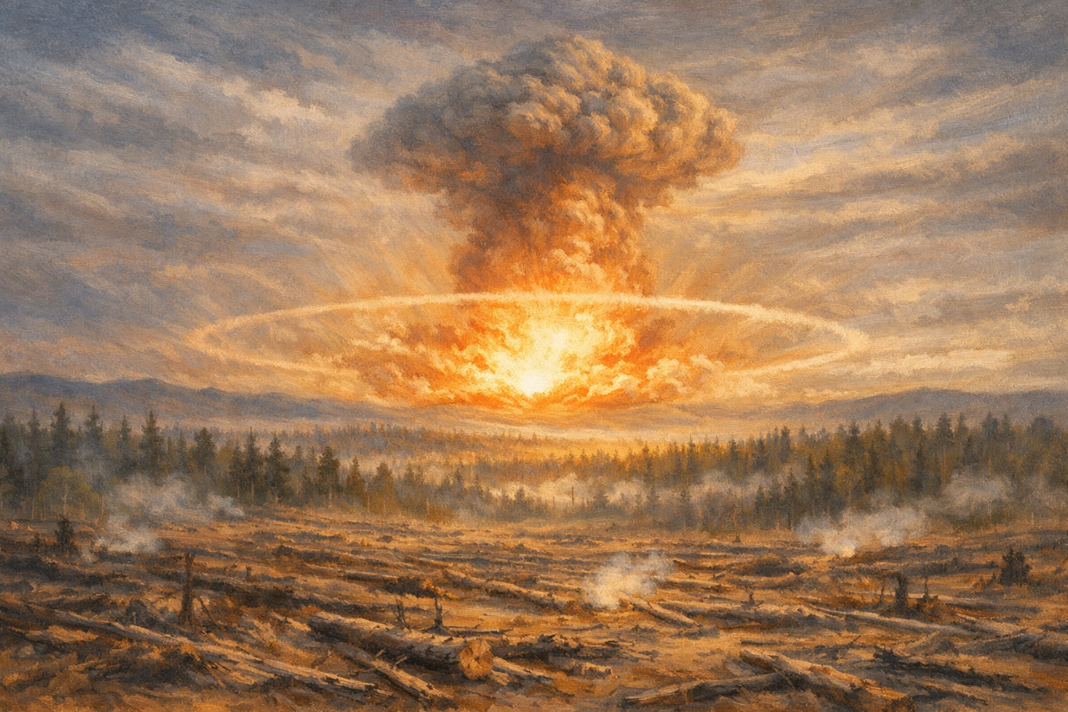


A massive explosion tore through the remote Siberian taiga near the Tunguska River in Yeniseysk Governorate (now Krasnoyarsk Krai), Russia on this day in 1908, flattening more than 80 million trees across an area larger than the entire state of Rhode Island.
The blast released energy estimated at 10–15 megatons of TNT — hundreds of times more powerful than the bomb dropped on Hiroshima — making it the largest explosion ever recorded in human history.
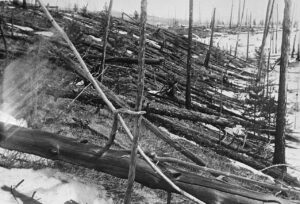
Witnesses described a fireball streaking across the sky, followed by a shockwave that shattered windows hundreds of kilometers away. Night skies glowed for days across Europe and Asia, bright enough for people to read newspapers at midnight. Yet no crater was ever found, and no fragments of an impactor were recovered.
Most scientists today believe the Tunguska Event was caused by an icy comet or stony meteoroid that exploded in the atmosphere before reaching the ground — an “airburst” powerful enough to devastate the forest below. But the absence of physical remains has kept the mystery alive for more than a century.
The Tunguska Event remains one of the most extreme natural phenomena ever witnessed: a cosmic reminder of Earth’s vulnerability, and a benchmark for understanding the destructive potential of near‑Earth objects.