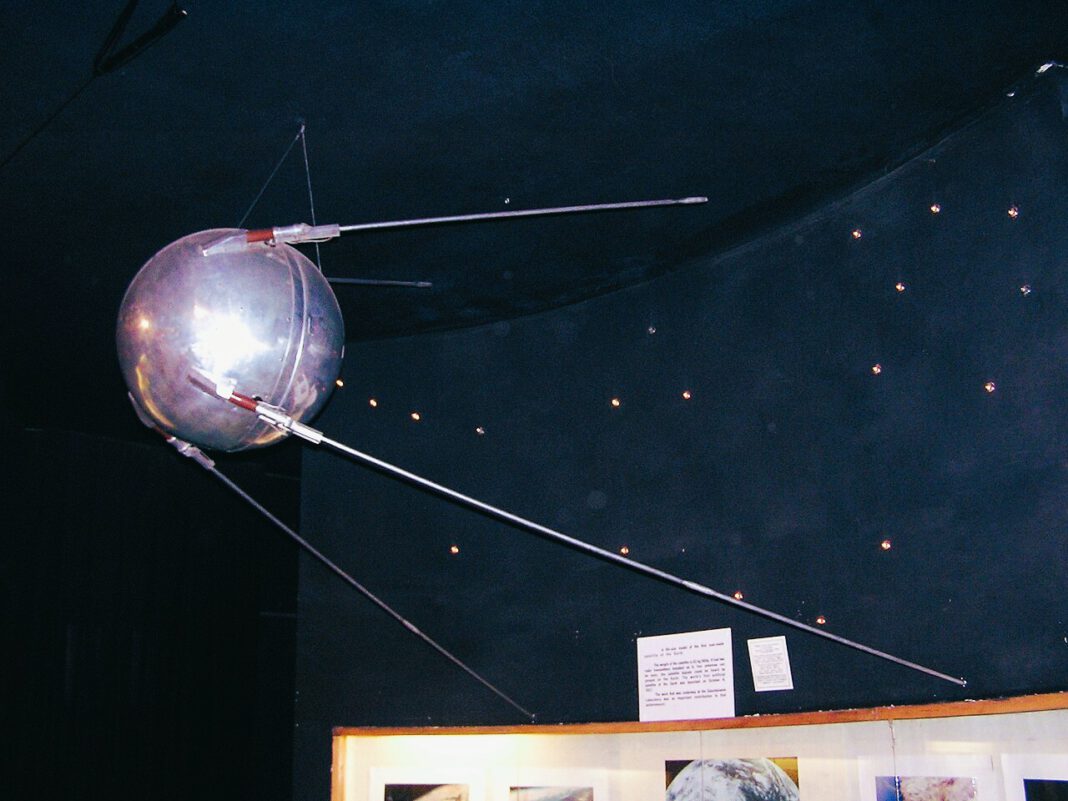


The Soviet Union launched the first artificial satellite into orbit on this day in 1957. Sputnik 1, developed under the Sputnik program with rocket engineer Sergei Korolev as chief designer, became the world’s first man‑made object to circle the Earth.
Sputnik’s mission was modest but groundbreaking. It helped identify the density of the upper atmosphere by tracking changes in its orbit and provided valuable data on radio‑signal behavior in the ionosphere. Yet its scientific achievements were overshadowed by its geopolitical impact. The unexpected announcement of Sputnik’s success stunned the United States, triggering the “Sputnik crisis” and igniting the Space Race — a defining chapter of the Cold War.
The idea of an artificial satellite, however, long predates Sputnik. In 1687, Isaac Newton published his famous thought experiment known as Newton’s cannonball, demonstrating mathematically how an object could orbit Earth if launched with sufficient velocity. The concept later entered literature: in 1869, Edward Everett Hale imagined a brick‑built satellite in his short story The Brick Moon, one of the earliest fictional depictions of orbital flight.
By the mid‑20th century, the satellite had moved from imagination to engineering. In 1946, the United States Air Force’s Project RAND released Preliminary Design of an Experimental World‑Circling Spaceship, declaring that “a satellite vehicle with appropriate instrumentation can be expected to be one of the most potent scientific tools of the Twentieth Century.” The U.S. Navy had been considering orbital satellites since 1945, and American astrophysicist Lyman Spitzer proposed an orbiting space telescope that same year.
Throughout the early 1950s, RAND continued to refine the scientific case for satellites. Reports such as Scientific Uses for a Satellite Vehicle (1954) and The Scientific Use of an Artificial Satellite (1955) outlined the vast potential of orbital instruments for research, communication, and global observation. These studies viewed satellites as tools of science, politics, and propaganda — but not yet as weapons.
Despite this early American interest, the Soviet Union moved faster. On 4 October 1957, it placed Sputnik 1 into orbit, beating the West to the milestone and ushering humanity into the space age.